

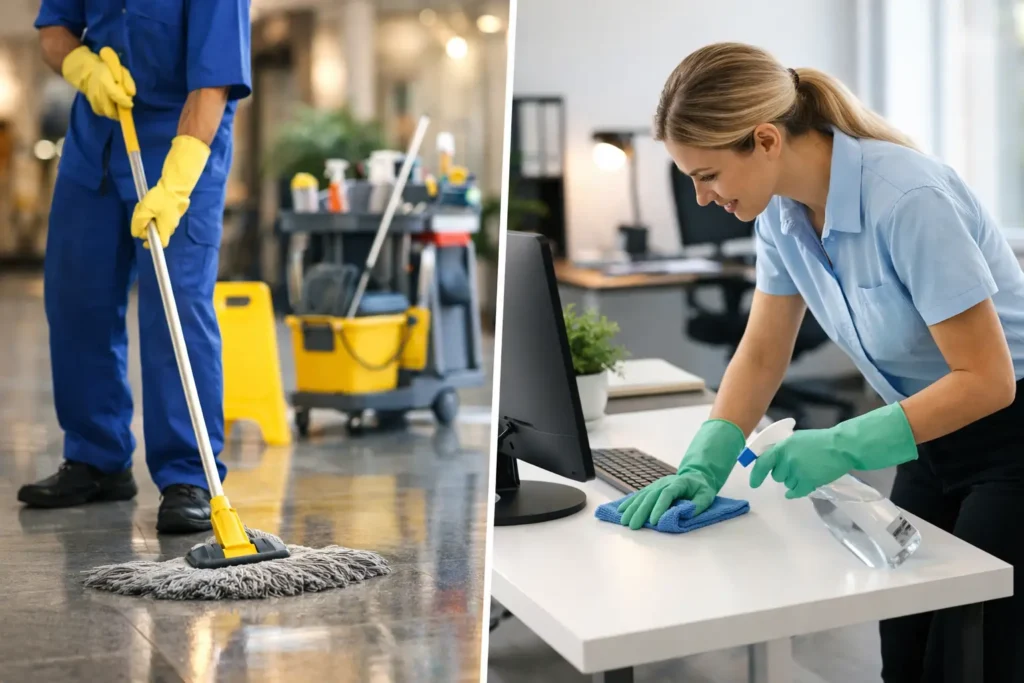
A clean workplace should not become another item on your team’s already full to-do list. When comparing janitorial versus office cleaning, the difference usually comes down to frequency, scope, and how much ongoing support your facility needs. The right choice keeps employees comfortable, gives visitors a better first impression, and helps your business stay ready for the next workday.
For offices and customer-facing businesses across Atlantic and Cape May Counties, there is no one-size-fits-all answer. A small professional office may only need detailed cleaning once a week. A busy facility with high foot traffic, shared restrooms, and a reception area may need service every night. Knowing what each term means makes scheduling easier and helps you pay for the care your space actually needs.
Janitorial cleaning is recurring, routine facility care. It is designed to keep a workplace orderly, sanitary, and presentable on a daily, nightly, or several-times-per-week schedule.
Think about the cleaning needs that return every day: restroom cleanup, trash removal, vacuuming, mopping, wiping down touchpoints, and straightening common areas. Janitorial service handles these repeatable tasks so dirt, odors, clutter, and germs do not build up between visits.
A janitorial plan is often the best fit for businesses with regular activity. That can include medical and professional offices, retail spaces, property management offices, community facilities, restaurants with administrative areas, and any workplace where staff and customers share the same environment.
The value of janitorial care is consistency. Instead of deciding each week whether the office needs attention, you have a dependable schedule and a clear task list. Your cleaning team learns the layout of the building, the high-traffic areas, and the details that matter to your operation.
Services may include emptying waste and recycling, cleaning and restocking restrooms, vacuuming carpets, mopping hard floors, dusting reachable surfaces, cleaning breakrooms, and disinfecting commonly touched areas such as door handles and light switches. The exact checklist should match your facility, not force your facility into a generic package.
A daily schedule makes sense when there are many employees, frequent visitors, or public-facing areas that need to look their best each morning. Two or three visits per week can work well for smaller teams. The key is choosing a frequency that prevents problems instead of catching up after they have become noticeable.
Office cleaning is a broader term for cleaning services focused specifically on an office environment. It can be recurring, but it can also be a one-time or occasional service. In other words, office cleaning describes the setting and the work, while janitorial service usually describes an ongoing maintenance arrangement.
An office cleaning appointment may cover the standard essentials: dusting desks and ledges, vacuuming, cleaning restrooms, wiping the breakroom, and taking out trash. It may also involve a deeper reset after a busy season, a tenant move-out, construction work, an office event, or a long stretch without professional cleaning.
For many local businesses, office cleaning is the practical starting point. A company may book weekly service, then adjust to twice weekly when the team grows. Another may need a detailed clean before reopening a suite or welcoming clients for an important meeting. Flexibility matters because life is busy and unpredictable, and business schedules change too.
A well-planned office cleaning service can include tasks that do not need attention every visit. Baseboards, interior glass, detailed dusting, carpet spot treatment, appliance cleaning, and hard-to-reach areas are good examples. These jobs take more time, so they are often added monthly, quarterly, or when the space needs a fresh start.
Carpet cleaning is another consideration. Routine vacuuming supports a tidy office, but it cannot fully remove embedded dirt, stains, or the dull appearance that develops in entryways and under rolling chairs. Periodic professional carpet cleaning can extend the life of flooring and improve the feel of the entire space.
The terms overlap, and some cleaning companies use them interchangeably. Still, the distinction is useful when you are choosing service.
Janitorial cleaning is generally the ongoing program that keeps a facility functioning well from day to day. Office cleaning is the service category for work performed in offices, whether that work happens weekly, monthly, or as a one-time project.
A small accounting office with eight employees may refer to its weekly appointment as office cleaning, and that is completely accurate. If the same business needs nightly restroom care, daily trash removal, and regular supplies monitoring, it is moving closer to a janitorial arrangement.
Neither option is automatically better. The best choice depends on the activity inside your building. A quiet office with low foot traffic does not need to pay for nightly cleaning just because another business does. On the other hand, waiting too long between visits in a busy workplace can create a poor experience for staff and guests.
Start with how your workspace is used, not just its square footage. A compact office with a busy lobby may need more care than a larger office where most employees work remotely. Restrooms, breakrooms, entrances, and shared meeting spaces usually tell the real story.
Consider how many people use the building each day, whether customers visit regularly, how quickly trash accumulates, and whether employees eat on-site. Also look at your floors. Sand, rain, and seasonal debris can show up quickly at South Jersey entrances, especially during wet weather or busy shore-season traffic.
For a low-traffic office, weekly cleaning may be enough to keep the workplace comfortable and professional. Twice-weekly service often works well for teams with shared spaces and regular visitors. Daily or nightly janitorial service is usually the better fit for high-volume facilities, customer-facing businesses, and offices where cleanliness directly affects public confidence.
It also helps to separate routine work from periodic deep cleaning. Your recurring visit can maintain the space, while scheduled detail work handles carpet care, high and low dusting, interior glass, and other areas that need extra attention. This approach protects your budget without allowing neglected tasks to pile up.
The service should feel easy to manage. You should know what is being cleaned, when the team will arrive, and who to contact if your needs change. Clear communication matters just as much as a clean floor.
Look for a local provider that listens before recommending a schedule. The best plan accounts for your hours, building access, staff needs, cleaning priorities, and budget. Eco-friendly products can also be a smart choice for offices with employees, customers, pets, or sensitivities to strong chemical odors.
Dependability is especially valuable when your business has early meetings, weekend traffic, or unexpected visitors. A courteous cleaning team that respects your workspace helps reduce the management burden rather than adding to it. That is the kind of practical support MopFrog Atlantic City aims to bring to local businesses.
Whether you call it janitorial service or office cleaning, the goal is simple: a workplace that looks cared for when people walk in and feels comfortable throughout the day. Choose a schedule based on real traffic, real priorities, and the level of detail your employees and customers deserve. A clean office is one less thing to worry about, and one more way to show people they are welcome there.

Ut elit tellus, luctus nec ullamcorper mattis, pulvina.